Firsties Wild about Letter Writing (Plus..a sale!)


Can we all just take a moment to recognize how awesome our little learners are? Forget the test scores, forget academic buzzwords, forget the standards for a second, and think of your kids when they walked into your classroom on the first day of school. I welcomed 19 students into my class this year with a wide range of abilities. On the first day of first grade, many of my kiddos were non-readers, unable to write a complete sentence or solve a simple math problem. 

When I look at my students now, I'm amazed at their growth! As a first grade teacher, I always feel that these incredible gains are most apparent in their writing. My students started the year using guided writing activities to tell me what they like...now, they are writing opinion pieces, reports, narratives, and - my favorite - friendly letters!

In the digital age, it can be easy for us to forget that letter writing is a life skill. I'm always sure to remind my students of this. As older students and grown up, they will be expected to write letters in many different forms. Emails, thank you notes, cover letters...the list goes on and on! I love that we are preparing them for these experiences already in first grade.

Like many of you, I use the Adams family parody to teach the five parts of a letter: heading, greeting, body, closing, and signature. We take some time to get familiar with this by labeling letters that I've written. This is an important first step! 


After some more modeling and guided writing experiences, it's time for the students to write their own letters. For day one of letter writing, we all write to the same person. This year, my students chose to write to our "next door teacher," Miss I. Again, we start with a guided writing experience to model proper format, grammar, and spelling. We then build a temporary white board word wall together to determine which words we might need while writing our letters. Then, I release my kiddos to write their own letters using differentiated writing paper

On day two, students are given more freedom...they are able to write a letter to anyone who learns or works at our school! This year, most of my students wrote to their Kindergarten teacher and told her all about first grade. I thought that was so sweet! We put all of our letters in a mailbox in our writing center (pictured above) to be delivered. Some of my co-workers take the time to write back when they receive their letters...the kids are so happy when this happens! 


Day three of our letter writing week is always my favorite. My students write to celebrities! Over the years, my kiddos have written to Taylor Swift, Hillary Clinton, LeBron James, and everyone in between. We've even had some responses from these celebrities! In fact, here is a list of famous people you can write back to who will respond. This little list is tried and true. My firsties have written to these addresses and received responses all within the past few months!

  • The President of the United States, The White House, 1600 Pennsylvania Ave, Washington, DC, 20500
  • Mickey Mouse, The Magic Kingdom, 1675 N Buena Vista Drive, Lake Buena Vista, Florida, 32820
  • Her Majesty the Queen, Buckingham Palace, London SW1A 1AA
  • Michael Jordan, Jump, Inc., 676 North Michigan Ave, Suite 293, Chicago, Illinois, 60611
  • Miss America, MAO, PO Box 1919, Atlantic City, New Jersey, 08404
  • Your Miss America State Title Holder (find your state on missamerica.org, then find their "Contact" link)
  • MLB teams and their minor league affiliates (Pick your team on MLB's website, then scoll down to click "Contact")
  • NFL teams (Pick your team on NFL's website, then scoll down to click "Contact")
  • Local politicians (a quick Google search will help you find an address!
For all other celebrities, I simply Google their name plus "fan mail address" and choose the most reliable address. Some celebrities have their fan mail address on their website, but I've also used fanmail.biz. On each students' letter, I place a simple note that says, "We'd love to hear back from you!" with our school's address.

The most exciting part comes next...we begin to receive letters! Look who wrote to us this year right before he left office!


Of course, I remind students that we may not hear back from every celebrity. After all they are very busy people and have many important things to do. I've found that this does not discourage my students at all. In fact, if time goes on and they haven't received a response, my students oftentimes head to the writing center and write to someone new! We send out letters to people all over the world throughout the year, and have had some great responses and new-found pen pals.

As with all writing assignments, I use a rubric to grade my students' letters. I like to differentiate my rubrics for the simple reason that my students have a wide range of ability levels. Differentiated rubrics challenge all of my students yet give them opportunities for success, no matter what level of writing they are working at! 

Check out my Differentiated Letter Writing Kit, now on Teachers Pay Teachers! This kit has made letter writing assessment so much easier for me this year. In this kit, you will find three leveled rubrics, draft letter writing papers, plain writing paper, and seasonal writing paper. Each letter writing format is differentiated to meet the needs of your students. This 56 page resource is sure to help you all throughout the school year. And...just for you, it's on sale for half off for the first 24 hours! Click here to enjoy this savings (sale ends Monday, January 30, 2017 at 3:00 PM EST).


Happy letter writing!

Local Celebrities Bring New Life to Books

Start a Celebrity Reader Program in Your School!

Celebrity Reader Miss Ohio 2015, Sarah Hider reads Stand Tall Molly Lou Melon.


As teachers, we generally have a very open love affair with books. Big books, small books, silly books, serious books, adult books, kid books...we love 'em all! 


How amazing and hilarious is this display from the Virginia Beach Public Library?!
Unfortunately, our students don't always agree. I work with children that don't have many books (if any!) in their home. They aren't read a story each night, they don't see adults modeling reading habits, they don't see reading for the life skill that it is. It's an unfortunate reality for many of today's children.

I'll never forget the moment this shocking truth hit me...I was a pre-service teacher observing in a HeadStart in inner city Pittsburgh. A brand new kiddo was wide-eyed as he experienced his first day of school. At one point in the day, he casually plucked Goodnight Moon off the shelf, and exclaimed, "What is this thing?" My heart broke as I realized this child had never come in close contact with a book before. 

Because of their lack of exposure at a young age (along with many, many other factors), a large percentage of my firsties are struggling readers. Picking up a book doesn't give them joy...it makes them feel anxious. Let's face it, deciphering the English language is hard work! It's our job as teachers to make reading as engaging and as interesting as we can so that those anxious feelings some of our students have turn into wild excitement. After all, reading books opens us up to corners of the universe we could have never possibly imagined! What a thrilling, beautiful power.


With the goal of getting kids excited about books, I started a celebrity reader program in my school three years ago. The idea was simple: At the start of the year, I'd reach out to local celebrities, asking them to come read to our kiddos and share about their job. After getting confirmations, I create a schedule for the year, making appointments with one celebrity reader a month. On the big day each month, our celebrity reads an amazing book and then answers questions about his or her job (and how it's essential to be a good reader for that job!). 

In its infancy, I could not have imagined the impact of this program on my students. Now, it's one of our most exciting days each month! We keep the identity of the celebrity reader a secret until he or she walks in the door, which really builds the anticipation. Even though the kids guess that Ninja Turtles, Bruno Mars, or Doc McStuffins are coming into read to us, they are never disappointed by our local celebrities. Kids also get an amazing real world connection; they learn about careers they may not know much about, and see how reading is important in those different jobs. 

Celebrity Reader Scrappy and his "handler" from the Mahoning Valley Scrappers read Bats at the Ballgame.

Start Celebrity Story Time in your school! 


1. First and foremost, get permission from your administrator. Your school may have rules about who can visit your school, what clearances they may need, and what times they can come in to visit. Luckily, our principal is very supportive of this program. We keep her updated of our schedule throughout the year, and run times and locations by her as needed.

2. Next, decide on the logistics. Who will the audience be? How often will celebrities visit? Where will you host your readers? What time will they visit? How long will they visit for? Our monthly Celebrity Readers visit the entire first grade (about 80 students) at once. We usually all squeeze into one classroom, but if a reader needs more space or a presentation area, we ask for permission to use our media center or high school auditorium. More often than not, the classroom works just fine. Our average reader stays for about 20 - 30 minutes. Some of our readers travel a bit further to see us, so we try to stretch their visit to make it worth their while. To accomplish this, we ask other grade levels if they are interested in a visit or have a "Celebrity Lunch" with the kids or staff.

3. The most exciting part is picking your celebrities. I promise that even the smallest of towns has a full host of local celebrities to choose from! Here are some amazing groups of people that we have had success with in the past:
  • Local News Personalities: Kids love to hear about reading on a teleprompter. These are some of the most expressive celebrity readers we have hosted!  
Celebrity Reader Derek Steyer from Channel 21 News reads Three Nasty Gnarlies.
  • Local Politicians: Politicians are always a huge hit with the kids, especially during an election year. "You're like the president of our city?! Whoa!"
Celebrity Reader County Commissioner Dan Polivka reads Duck for President.

  • Authors: Authors are always looking for schools to visit, but can sometimes come with big fees. Still, you may know of a local author who is willing to work with your students for free in exchange for promoting their book! Contact your local university...both our author visits have been from professors at my alma mater, Slippery Rock University!
Celebrity Reader Dr. Anne Slanina reads her book Annie Mouse Meets a New Friend.

  • Service Men and Women: These heroes are especially impacting around Veteran's Day. Students love to see them in full uniform!
Celebrity Reader Dr. Snyder reads his own book What is a Veteran, Anyway?

  • Athletes: It's likely that many of your students have dreams of growing up to play sports professionally. We were lucky enough to have a connection with a player for the Steelers. Not as well connected? Reach out to your local minor league team. High school athletes also make great role models. 
Celebrity Reader Mike Adams of the Pittsburgh Steelers with first grade staff.

  • Pageant Queens: As a former local titleholder in the Miss America Scholarship Program myself, I can tell you firsthand that these ladies are more than just "beauty queens." Most have platforms, or a social issue, that they are eager to spread awareness about! 
Celebrity Reader Gabriella Morando, Miss Michigan Junior High 2015, reads Chrysanthemum. 
  • Building Staff: Does someone at your building wear a different hat outside school hours? Show your students' a different side of a familiar teacher by inviting them in as a celebrity reader. The kids will go nuts! During my first year of teaching, I was still competing for Miss Ohio...at the end of the year, I visited my students as "Miss Clayland" instead of "Miss DePizzo." It was an amazing experience as a teacher and titleholder!
Celebrity Reader Jenna DePizzo (me!), Miss Clayland 2015, reads My Pal, Victor.

4. Once you have your list, it's time to contact those celebrities. I've found email to be most effective. Feel free to copy and paste this form email that I use for my initial contact with celebrities!

Hello! I hope you’re doing well!

I can’t believe another school year is starting up again! I am a (grade) teacher at (school) in the (district), located just outside (nearest city). I am looking for local “celebrity readers,” and thought instantly of you!

The (grade level) team is hoping to host one celebrity a month to read a book to the students. We hope “Celebrity Story Time” will not only encourage our students to read, but also show them many different kinds of jobs in the community. [Make a connection to the reader here, like this: We learn about the news and weather in first grade, and thought this would be a perfect connection.]

If it works for your schedule, we would love to have you come in one day this school year to read to our students. If you are interested, please let me know if a certain time of year works best for you. I look forward to hearing from you!

5. Then, it's time to coordinate your schedules and give further details. You may need to be flexible, depending on your reader's job. Morning might be best for a reporter, but terrible for an athlete. You'll want to be clear about the visit: How long should it last? What is expected? Are you picking out the book, or will they come with one? What topics would you like them to discuss?  

6. Before your celebrity arrives, spread the word! It's, of course, important to share the schedule with other teachers and your administration. You may also want to contact your local newspaper. Several of our celebrity readers have been featured in the local section of our newspaper!

Celebrity Reader Mackenzie Bart, Miss Ohio 2015 and ventriloquist, visit to teach about STEM.
7. Next, you'll want to make reminders. The week of the visit, send out a quick email to your staff and reader to remind them of the details of the visit. This ensures that everyone is on the same page schedule-wise. 

8. After all that planning, you're now ready to host celebrity readers at your school! Upon arrival, I send down a couple of students to greet our reader with a handshake to welcome them to our school. The celebrities get a kick out of that! Be sure to take lots of pictures, and post them to Instagram using the hashtag #CelebrityStoryTime. 

9. Be prepared to help monitor behavior and lead the discussion during and after the reading! Depending on your reader's background, he or she may not be comfortable addressing students' chattiness or other behavior issues during their reading. In addition, they might not be sure how to steer the kids into asking meaningful questions. That's where you should step in!

Celebrity Reader Miss Ohio 2015, Sarah Hider reads Stand Tall Molly Lou Melon.

10. After each visit, be sure to send thank you notes! No matter how big or small your celebrity's status, they've taken time out of their day to spend time with your kiddos and enrich their love of reading. Whether it be heartfelt thanks from the teacher, a group note from the class, or individual letters, thank yous are a must! They also help build a relationship with the celebrity reader...you may have some you'd like to invite back year after year.

How do you get your students excited about reading? Do you have a similar program at your school already? Thinking about starting your own Celebrity Story Time, but need some more direction? I'd love to hear about it in the comments! Remember to tag your photos with #CelebrityStoryTime so I can check out what's going on in your school! 

"Snow" Place I'd Rather Be Than First Grade!

Looking for my best selling Melted Snowman Craftivity? Click HERE to read my new, updated blog post!

I may be a bit late but...Happy New Year! I hope you had a restful, relaxing, much-needed winter break. Personally, I spent my time off wedding planning with my fiance. We are so excited for what this year will bring for us!

Coming back from break has always been hard for me...and not just because I have to start wearing real pants again. I always hit the hard realization that half of the school year is over and start to panic. Are my students halfway to their reading goals? Have I covered enough standards? Will we meet our SLO? My natural reaction is to come back in January with my eye on the prize, hitting the ground running and never looking back.
While I may have had good intentions, I was always met with resistance from my firsties. Who can blame them? They come back from break refreshed...but also wildly out of routine. This year, I slowed it down for our first couple days back, in hopes for a better transition. Check out these awesome FREEBIES for some winter fun and an easy transition back into your normal routine!
Here in Ohio, if there’s one thing I can guarantee for each January, it’s snow. Lots and lots and LOTS of snow…which makes snowmen the perfect theme for the month.

We eased our way back into math after the long break with this easy craftivity. Back in December, my best friend and fellow teacher down in Texas sent me photos of this beyond adorable craft that she created with her preschoolers, perfect for shape recognition. I was determined to modify it into a first grade activity!


Up to this point in the year, we have focused almost entirely on addition and subtraction skills. Adding an addition and subtraction review to the craftivity made the project perfect for first! Students sat on the carpet with whiteboards, markers, and erasers. We studied the chart, and solved each math problem to find out how many pieces we needed to make our melted snowmen. For example, we started with an easy subtraction problem to find out how many pieces of blue paper we needed (one!). Once we solved this, we returned to our seats, grabbed a blue piece of paper, wrote our names on the back, and returned to the carpet once again to solve the next fact. We then moved on to the next problem.


Breaking the project up like this gave kids a little break between each math problem. What they didn’t realize is that they were still working on their math skills while working on their melted snowmen!


Again, I don’t give the kids a pattern for this. I think their projects turn out much cuter this way! This project is the perfect way to transition into more rigorous academics, and ease the students back into routines and procedures after break.


For the full directions and easy printable guides, get the freebie on my TpT HERE!

How do you transition your students back from a long break? Sound off in the comments to share your ideas!

Curing the Christmas "Gimmes" (plus a freebie!)

It’s the most wonderful time of the year! Cold weather has settled here in Ohio, and the holidays are right around the corner. Like many other teachers, I set out special paper in our writing center for the students to write letters to the North Pole. I couldn’t help but notice that each of my students’ letters followed a very similar pattern: “Dear Santa, I want...I want...I want…” It seemed that my little firsties had a terrible case of the "gimmes," as my mom would say. More than that, I realized they had no concept of differentiating their wants from their needs. It was the perfect moment to mix holiday fun with life lessons and social studies standards.


I set to work creating a Wants and Needs mini unit, full of no-prep printables made for busy teachers on the go. Here’s how I used it in my classroom!


On Monday, I opened a discussion with my kiddos about their Christmas wants and needs. We made a list of the top 5 things we want for Christmas, along with 5 needs for Christmas. It looked a little something like this:


My firsties were loaded with more misconceptions than I thought! I did not correct their list, but gave each student their own informational mini book. My favorite part about these mini books is that they are differentiated. Even though the images and content are the same, the books are written to meet students’ various reading needs. Students simply find a buddy “by shape” (books are coded with a circle, triangle, or square on the front cover) and get to reading.


After, we met back at the carpet to talk about wants and needs. We recorded a definition of each on an anchor chart to reference throughout the week. Then, I asked my students to look at their original list again. We read through each “want”...is it truly a want? We agreed that our wants were accurate. Then we looked at our list of Christmas needs. This side of our list caused a lot of debate. My students argued that a tree is a need, since it creates air to breathe (What smarties! We would get to a decorated Christmas tree vs. a standard tree later in the week). Cookies, they continued, are a need because they are food. Questionable, but I left it on the list for now. Snow, they decided, is a want, because not all people in the world have snow and we would be ok without it. We crossed it out. They easily decided that wrapping paper is definitely a want, and family is surely a need.


We discussed some more topics in our mini books, and then completed a fun coloring sort together. We decided candy is a want because it’s not a healthy food to help our bodies grow. This caused us to go back to our original list and cross out “cookies.” They were catching on! It was very interesting to hear students’ argue their reasoning for different items, especially coffee! One student told me, “My mom needs coffee for sure, or she is a real grouch!” How funny!


On Tuesday, I allowed my students to create their own flip books working in groups. They colored picture cards, cut them out, and sorted them into “wants” and “needs.” After I checked their work, they were able to glue their cards down under the proper flap and color their flip book. Again, the conversations this project initiated were wonderful! I love it when an activity fosters natural academic conversation between students.


For Wednesday’s project, I cut two large, red sacks out of butcher paper. I gave each student two small pieces of white paper, and asked them to draw and label one thing they want for Christmas and one thing they need. Some of my students struggled with this, and instead drew two wants. I conferenced with each as they worked and prompted them with questions: “Would you be able to live without this?” “Do you need this to survive?” If they were still stuck, I asked them to explain their thinking to a friend. Soon, each student had two cards with a want and a need! I gathered them all, mixed them up, and handed each student two cards. We had so much fun admiring our friends’ art and sorting the cards into Santa’s sacks!


Thursday was a bit more challenging...instead of thinking of our own wants and needs, we thought of others’ using this handy guide:


This was definitely tricky for my firsties, but I was proud of their work. This firstie said that something I wanted was "quiet"! Lol! After, we used our guides to write a letter to Santa...again, with another person - not ourselves - in mind. This, too, challenged my students! I was far more impressed with these letters than the letters my students produced before starting mini unit. They were finally thinking of others, and were very particular about their requests. They also wrote to Santa about not only wants, but needs as well.


We ended the mini unit with one of my favorite assessments...a search and find "shopping trip"! I had my kiddos bring in magazines and ads from home. They then searched for wants and needs to sort into their sacks. The kids had a ball with this activity. Some of them even filled up multiple papers! Once more, the conversation between my firsties was incredible. They learned just as much from each other as they did from me. Success!


You can snag the complete mini unit here on TpT for just $5.00! It is also a part of my December Mini Unit series, a steal at just $9.00. The 31 page Wants and Needs Mini unit is aligned to the Common Core and Ohio's Learning Standards (social studies). You will find book suggestions, leveled mini readers, no prep printables, and a “Fun Friday” hands-on activity. Though this set is intended for the Christmas/Holiday season, it can be used year round (non-holiday versions of pages are included).


The following no prep printables are included:
• Leveled readers and comprehension guide
• KWL Chart
• Can, Have, Are Chart
• Secret Santa Chart (Non Christmas version also included)
• Labeling Wants and Needs
• Present Sort
• Coloring Sort
• Wants and Needs List Making Pages (3 differentiated)
• Fact Sheet
• Flip Book
• Letter to Santa (Non Christmas version also included)
• Story Problems
• Adding Money

Not sure yet? Check out the freebie sampler here. A Christmas gift from me to you! Happy holidays!


Ready, Set, Goals - Positive Behavior Management in the Classroom, Part Two

As I began to organize my thoughts and photos for this post, "Positive" from Legally Blonde: The Musical started playing through my head on loop...that's exactly how I strive to keep my classroom: positive! Of course, it can be incredibly difficult to keep your cool and think happy thoughts when one of your students starts giving out unsolicited hair cuts or when a child removes an entire brick from your classroom wall (both of these happened within my first month of teaching - yikes!).

However, if there's one thing I've learned, it's that there's usually a reason for every behavior. I work in a low income district; many of my students have less than ideal home lives, and bring to school more stress than I ever dealt with as a six year old. Raising my voice and taking away recess proved unsuccessful time after time. This year, I made a vow to keep it positive when it comes to behavior management and have seen amazing results.

In addition to providing my students a safe space to release emotions and calm down (if you missed Part One of this series, check out my classroom Zen Zone here!), I also offer my students incentives for showing me stellar behavior. As a class, we discuss one of our behavioral struggles as a group. Are we forgetting to raise our hands to speak? Neglecting to be kind to our friends? Running in the hallways? We vote on our biggest "weakness" and then set a goal to work on it! The goal is posted in the room for students, staff, and administration to see. This helps keep us accountable.


Here's a close up. I typed up a simple goal sheet on Microsoft Word. The adorable pennant is from an Edible Banner Kit on TpT.


You'll notice that there's also a reward. The students choose this, too. My kiddos have picked some great rewards over the years: a GoNoodle party, a shoe free day, extra center time, cookie decorating. As long as it's within reason, I give it the green light. This year, I even have some awesome parents who have offered to "sponsor" a behavior goal party (more on that later)! 

We then get to work on our goal. Our first two goals of the year have been centered around talking (I have a chatty bunch). I stuck some magnets on the back of basic bulletin board letters and posted them at the top of the white board. When students get too rowdy, I remove a letter.


At the end of the day, if we still have letters left, we earn a "donut." We need eight donuts to earn our party! We keep our paper donut awards on the whiteboard or a bulletin board so we can see how close we are to reaching our goal. I use this method for all of our rewards. Here's an example from last year...my students needed to earn six scoops for their ice cream party. With each new goal, we bump up the number of days we need to meet our goal in order to earn the party. 


It usually takes my class anywhere from three to six weeks to earn their reward, depending on the goal and their dedication to it. Our behavior reward parties are very short (about ten minutes) and are usually held during snack time. Of course, not all rewards cost money...but some do. As a teacher on a budget, I always go the cheap route. For example, a "brownie party" is a boxed mix and basic ingredients I already have at home. This year, I have been incredibly lucky to have a few parents ask to "sponsor" our behavior reward parties. Once we earn a party, I reach out to them and they either drop off the reward at school or send in a gift card for me to make the purchase. Last week, my students got to enjoy a donut party, sponsored by one of my amazing parents! 


To encourage my students to work as a team and have speedy transitions from one task to the next, I created a simple point system. Again, this is posted in a corner of my whiteboard. At any given time, I give points to the table that is serving as a great example to the class. At the end of the week, the team that earns the most points gets to select their centers first for "Friday Freedom" (play center time on Fridays). The winning team also gets to "wear a crown" for the entire next week.


Of course, the "winning" team is always changing, as points are awarded many times a day throughout the week. At the end of each day, the team with the most points is awarded the coveted "Quick and Quiet trophy." Who knew I'd ever have a practical use for all those rabbit trophies from my 4-H days!


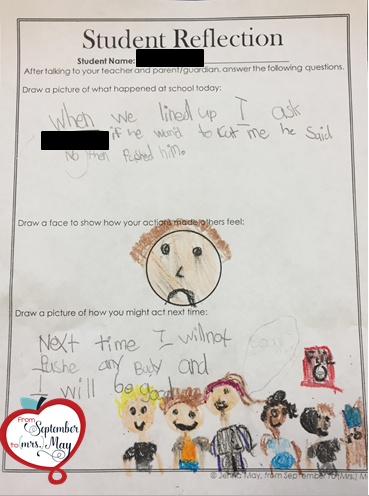
Even with these system in place, I still do have the occasional repeat offender. If the Zen Zone is failing us, I ask the student to please stop, think, and reflect. They are given a reflection page to work on in an isolated area of the room, which then gets sent home for their parent to sign and return. I have various levels of reflection pages to accommodate for my wide range of abilities.


If the behavior is frequent or severe, I send home a Pink Slip. This is an edible template you can find on my TpT store that I use to communicate with parents and administration (if needed). Students can complete a reflection at home with their parents before returning the Pink Slip to school. 


If a behavior continues, I immediately set up a behavior contract with the student and their family. We set goals, visualize, and set a reward.    


To keep students accountable, I give my student a goal tracking sheet and behavior card. The behavior card is printed on card stock, laminated, and written on with a dry erase marker. Tracking sheets have different themes to appeal to student interests!


By using goal setting and positive reinforcement, I have seen incredible changes in my students' behavior. Even better, I have noticed that my students' have become more accountable for their actions and have a strong urge to work as a team to achieve. 

Looking for more? Check out my full editable Behavior Referral Set on TpT here.


Thanks for stopping by!

Freebie Alert!

Even though it's not quite Thanksgiving yet, I'm ready to deck the halls. What better way to start off the Season of Giving than with a flash freebie?!

My favorite products to make on TpT are integrated mini units. I started creating my new December mini unit series this week and just added a Nonfiction Reindeer Caribou mini unit to my store! Just for you...it's free for today only! Hurry! This offer expires on Saturday, November 19 at 9:00 PM EST.


In this integrated, no prep set, you will find book suggestions, leveled mini readers, no prep printables, and a “Fun Friday” hands-on craft. Students will enjoy learning about reindeer all week, then create a beyond adorable piece of art (pictured below) to display in your classroom! 

The following no prep printables are included in this 21 page set:
• Leveled readers and comprehension guide
• KWL Chart
• Can, Have, Are Chart
• Caribou on the Move Interactive Fact Sheet
• Label the Reindeer
• Fact Sheet
• Compare and Contrast (reindeer vs. caribou)
• Report pages
• Story Problems
• Addition and Subtraction Math Riddle 


I'm no artist, so simple crafts (without pesky patterns) are my jam. This little reindeer couldn't be any easier - or cuter! The full instructions are included in this mini unit.


Stay tuned...I'll be using this mini unit in my classroom this December, and posting all the updates here! Enjoy!

Firsties Go Zen - Positive Behavior Management in the Classroom, Part One

Before reading, please note: I realize that many amazing teachers have found great success using behavior charts in their classroom. This post is simply to share my experiences and to offer an alternative form of behavior management. 


This year, I went rouge and ditched my traditional clip chart. I know...some of you are in shock and the other half are screaming, "It's about time!" As a student teacher, clip charts were the main form of behavior management I saw in classrooms. From inner city schools to rural districts and every type of school in between, I knew I could walk in any elementary classroom and see a clip chart hanging quietly in the corner. The colors may change, but the lesson is always the same: do good, and move up. Do bad, move down.

Of course, when I set up my own classroom, it seemed natural to utilize a clip chart. I created my very own using cute, printed scrapbook paper and my trusty laminator, proudly printing each student's name neatly on a clothespin. I clipped them all on "Ready to Learn!" and eagerly awaited for my students to funnel in for their first day of first grade.

And it worked...for the most part. So why change something that still fit so easily into my classroom? This past summer, though, I realized something. The clip chart wasn't failing my classroom, but it sure was making my students feel like failures.

Sure, the clip chart (or most of them, anyways) offers redemption. Students who clip down to a "bad color" early in the day can be clipped up if they show improvement. But those minutes spent shamed on a bad color can stretch into eternity for our little ones. I also realized that the clip chart wasn't changing behavior, it was only tracking it. It was offering absolutely no support to my students who desperately wanted to be good, but had trouble following the rules.

Upon realizing this, I felt disappointed in myself as an educator. Still, I was determined to find an alternative. I searched the internet, talked to fellow teachers, and read lengthy research papers. Finally, a visit to my dear friend's classroom in Texas offered the perfect solution: the Zen Zone.

The Zen Zone, as I informed my students and parents alike at the start of the school year, is not a place for "time out". It is not a punishment and it is not a place a child should enter and feel shame. It's simply a place to take a break. The Zen Zone is where my students go to decompose, to think about wiser choices, or to just breathe for a moment.

For students (and teachers!), school can be frustrating, angering, and even saddening at times. These feelings sometimes make us act out in ways that might break school rules. Students also bring their worries from home to the classroom, which can have a strong effect on their behavior during school hours. Studies even show that children today bear more stress than ever before! Enter the Zen Zone...

A student may be asked to visit the Zen Zone, or they may visit by their own choice. They can stay as long as they need - though my average student needs less than three to five minutes to regain their composure and return to their seat or place on the carpet.

My classroom Zen Zone is by no means fancy. It does not take up a large amount of space, and was supplied using mostly dollar store items. I stapled some butcher paper to the back of an ugly bookshelf, slapped up a border, and hung a beyond adorable pennant from Instruct and Inspire's Editable Banner on TpT. I added two spare foam floor tiles that had been hiding away in storage and a pillow from my old couch for some comfort (I plan to spruce up this part of my Zen Zone in time, but this girl's on a budget!).


The most important tools in the Zen Zone can be found in a simple blue bin resting in the corner. Again, all of these are DIY or dollar store items!


I have various different calm down jars in the Zen Zone, which I made myself using these directions. I also included a stress ball and an old pair of headphones that I snipped the cord from. I turned a small photo album into a "Feelings Book," to assist my students with expressing themselves. The album also features photos of each of my students and their families. I have found the family photos to be especially helpful this year, as I have many students who don't get to see their parents often or just get homesick. I also have a clipboard and supply box in the Zen Zone (not pictured) for students who simply wish to work in a more secluded area of the room.

Perhaps the most useful tool in the Zen Zone, however, is the check in journal. Students may choose to journal their feelings while in the Zen Zone. Though it is not a requirement, most students do doodle or journal. Their writing offers me a lot of insight, especially for my students who are hesitant to talk to me about their feelings.


I also include some great children's literature that centers on feelings. I rotate them out fairly regularly, depending on how often the Zen Zone is being used and what students may be using it for.


This is my first year utilizing the Zen Zone, and I can't imagine going back to a clip chart. Having this additional "extra safe space" in my classroom has completely changed my students' daily behavior. I have noticed that they are more self-aware of their own emotions. They also are able to self-assess, choosing to visit the Zen Zone before poor behavior even occurs. My firsties are always telling me things like, "I almost made a bad choice because I was angry, but the Zen Zone helped me calm down." Easily frustrated or upset students are learning cooping mechanisms from repeated visits. Parents are even reporting that their child has created a Zen Zone in their room, and that it benefits their behavior at home. Success! 

Of course, chronic or severe behavior issues are not always solved by using the Zen Zone. Stay tuned for "Positive Behavior Management in the Classroom, Part Two" to learn about how I manage these types of behaviors in my classroom! 

Home Meet the Teacher Freebies Shop Contact Me Image Map Instagram Pinterest TpT Back To Top